
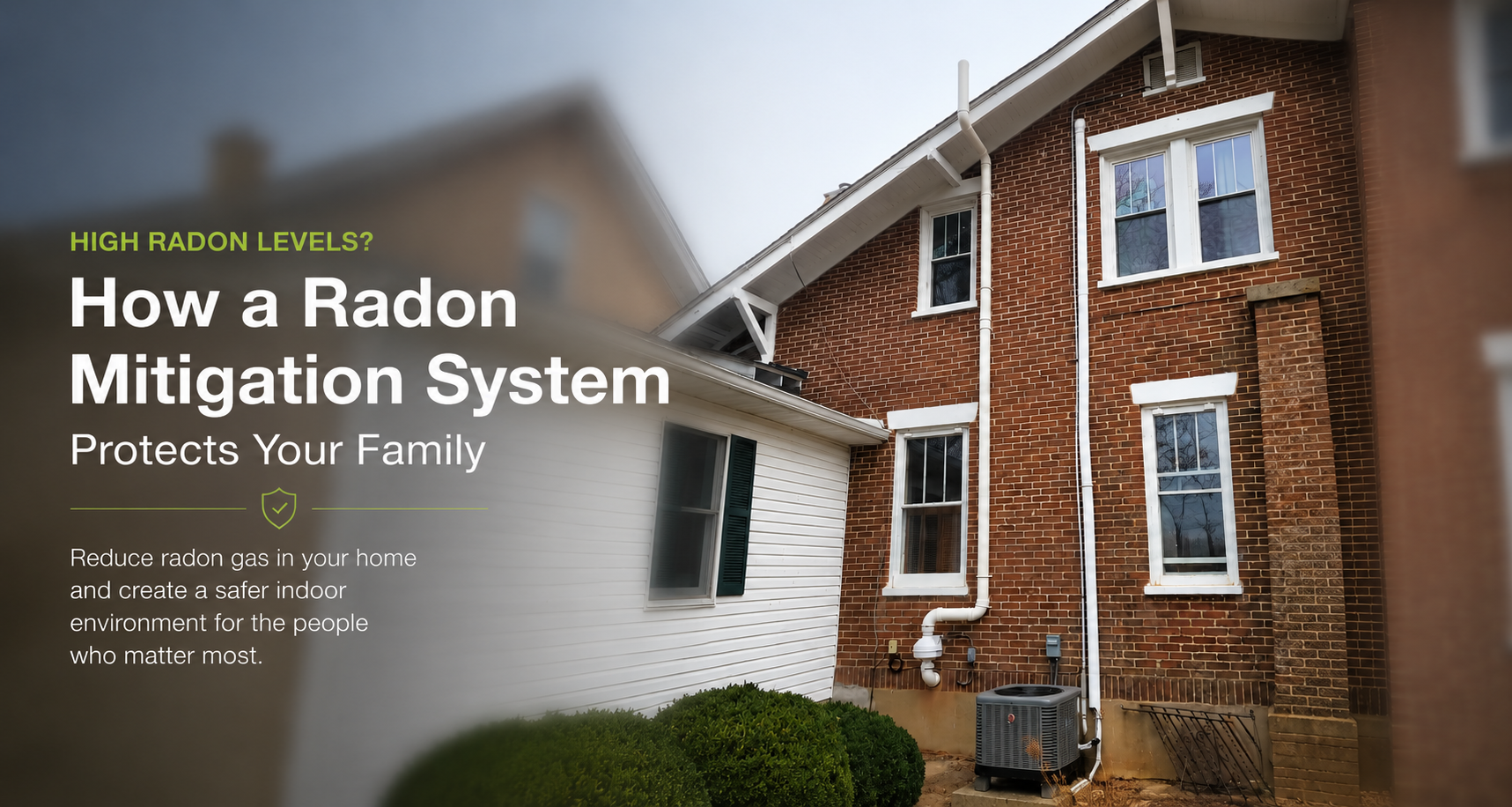
High Radon Levels? How a Radon Mitigation System Protects Your Family
Finding out that your home has elevated radon levels can be unsettling. You can’t see, smell, or taste radon gas, yet long-term exposure can put your family’s health at risk. The good news is that a high radon test result doesn’t mean your home is unsafe forever. An expertly installed radon mitigation system can significantly reduce the amount of radon entering your living space and help create a safer indoor environment.
At Astrid Environmental Services, we provide radon testing and radon remediation solutions for homeowners throughout Wytheville and surrounding areas. If your home has tested been for radon and the results are elevated, understanding how mitigation works can make your next steps much clearer.
What Is Radon, and Why Is It Dangerous?
Radon is a naturally occurring radioactive gas produced by the breakdown of uranium in soil and rock. It can move through the ground as one of several soil gases and enter a home through cracks, gaps, foundations, sump openings, and exposed soil in a crawlspace.
Once inside, radon can accumulate in indoor environments, particularly in lower areas of the home. Because radon is invisible and odorless, a radon test is the only way to determine your home's radon levels.
Long-term radon exposure increases the risk of lung cancer. According to the U.S. Environmental Protection Agency (EPA), there is no known safe level of radon exposure, and reducing indoor radon levels reduces the associated health risk.
What Radon Level Requires Action?
The EPA recommends taking action when radon levels are 4.0 pCi/L or higher. The agency also recommends that homeowners consider mitigation when levels fall between 2.0 and 4.0 pCi/L.
Radon concentrations are commonly measured in picocuries per liter, abbreviated pCi/L. This measurement tells you how much radioactive radon is present in a liter of air.
Even homes in areas considered to have lower radon potential should be tested. The EPA emphasizes that its radon-zone maps cannot predict the radon concentration of an individual home.
What Is a Radon Mitigation System?
A radon mitigation system is a system designed to reduce radon concentrations inside a building by preventing radon gas from accumulating in the home.
One of the most common approaches is active soil depressurization (ASD), including sub-slab depressurization for homes with concrete slabs. The system creates negative pressure beneath the foundation and draws radon-containing soil gases away before they can enter the living space.
The exact radon reduction system needed depends on factors such as the home's foundation, crawlspace, drain tile, sump pump configuration, and construction.
What Does a Radon Mitigation System Look Like?
Most systems are relatively unobtrusive. Homeowners will typically see PVC piping, a radon fan, an exhaust pipe, and a system monitor.
The vent pipe connects the area beneath the home to the outdoors. A radon fan creates the suction needed to draw soil gases into the piping and safely vent them above the home rather than allowing them to enter indoor spaces.
Depending on your home's construction, the system may also include:
A suction point through the foundation slab
Sealing around sump openings and other potential radon entry points
A plastic sheet or membrane over exposed soil in a crawlspace
A manometer or another indicator that shows whether the system is operating
Exterior PVC piping extending to an appropriate discharge location
Homes with crawlspaces can require a different approach from homes with basements or slab-on-grade foundations. That's one reason radon mitigation should be designed for the individual property rather than treated as a one-size-fits-all home improvement.
How Does a Radon Mitigation System Reduce Radon?
A radon mitigation system reduces radon by changing the pressure beneath your home and directing radon-containing gases outdoors.
With sub-slab depressurization, a radon fan creates suction beneath the concrete foundation. The vent pipe then provides a controlled route for those gases to escape outside. The goal is to intercept radon before it enters your living space.
For a crawlspace, a membrane may be installed over exposed soil and a fan-powered system can draw air from beneath that barrier. This technique is known as sub-membrane depressurization.
Simply sealing cracks in a foundation isn't generally enough by itself. The EPA notes that sealing is commonly part of radon reduction work but does not recommend relying on sealing alone to consistently lower radon levels.
Why Should Radon Mitigation Be Left to the Experts?
Radon mitigation requires more than attaching a fan to PVC piping. An effective system must account for the home's construction, foundation, pressure dynamics, radon entry points, and safe exhaust placement.
An experienced radon mitigation contractor can determine the appropriate soil suction strategy, install the system correctly, and ensure the radon fan and vent pipe are positioned to reduce exposure safely. Homeowners should also ask about testing procedures, warranties, ongoing maintenance, and the qualifications of the company performing the work.
The National Radon Proficiency Program (NRPP) is one resource for radon-industry credentialing. When you're dealing with a radioactive gas linked to lung cancer, expertise matters.
Do You Still Need to Test After Installing a Radon Mitigation System?
Yes. Radon measurement after installation is important for confirming that the mitigation system is successfully lowering indoor radon levels.
A system may have a manometer or other indicator that lets you know the radon fan is operating, but that doesn't replace a radon test. Testing provides the actual measurement of the home's radon concentrations.
Homeowners should also understand how to recognize whether their system is functioning and follow recommendations for future testing and maintenance.
Can New Homes Have Radon Problems?
Yes. A new home can still have elevated radon levels, even when radon-resistant new construction techniques were used.
Radon-resistant construction can incorporate features designed to make radon reduction easier, but homeowners should still test. If elevated levels are detected, a passive system may need to be activated with a radon fan or another mitigation approach may be necessary.
A newer foundation or compliance with building code requirements should never be treated as proof that a home doesn't have radon.
High Radon Levels Can Be Addressed
An elevated radon test can be frightening, but it also gives you something valuable: the opportunity to act. Radon is a radioactive gas that can accumulate unnoticed inside homes, but a properly designed radon mitigation system can reduce indoor radon levels and help protect your family from long-term exposure.
In short, test your home, pay attention to the results, and take action when elevated radon levels are found. If your results are at or above the EPA action level of 4.0 pCi/L—or you're concerned about the radon levels in your home—don't try to design or install a system yourself.
Contact Astrid Environmental Services today to schedule a radon inspection. Our experts can evaluate your home, explain your test results, and recommend a radon mitigation solution designed to help keep your home and family safer.
How Much Does a Radon Mitigation System Cost?
The cost of a radon mitigation system varies because every home is different. Foundation type, crawlspace conditions, the number of suction points required, system routing, and other construction factors can all affect pricing.
That's why an inspection is more useful than trying to estimate your project based on a generic online figure. Once your home's radon levels and construction are understood, an expert can recommend the appropriate mitigation approach and explain the expected costs.